The Lord of the Rings: The Rings of Power composer Bear McCreary opened up about the secret trick used to reveal Halbrand is Sauron in the show's first two episodes. Set in the Second Age of J.R.R. Tolkien's Middle-earth, The Lord of the Rings: The Rings of Power showcases the forging of the titular Rings and the start of the Dark Lord Sauron's reign. Season 1 ended by revealing Halbrand, who was Galadriel's trusted ally, was actually Sauron the entire time.
Speaking with Screen Rant in an exclusive interview, McCreary explained how music was a big hint at Halbrand's true identity, even in the first two episodes of The Lord of the Rings: The Rings of Power. He revealed Sauron and Halbrand share the same theme song, which was also composed with the One Ring in mind. Check out McCreary's full statement below:
It's interesting because I did give it away, if you are paying enough attention. Sauron's theme is Halbrand's theme backward. Same thing. [singing] Same thing. And I'm so obvious about it, I just state it over and over.
With that said, the colors are very different. The context is very different, but the clues are there. Every character has these big leaps and giant phrases that soar except Sauron. His is very circular; it's a ring. [singing] It comes back to the same note it started on over and over and over. Halbrand's does too, and I think even your subconscious mind might notice that of all our protagonists, this is the only theme that's small. But I'm trying my best to trick you. I'm using harmony and context, going, 'No, no, no, no. He's a hero. Don't pay attention to the notes.'
What's Next For Sauron In The Rings Of Power Season 2?
The Lord of the Rings: The Rings of Power season 1 ending saw Sauron attempt to turn Galadriel to his side, promising she would become his queen. However, Galadriel refused, forcing Sauron to travel to the newly-created Mordor alone. There's no doubt Sauron will encounter the dark Elf Adar and his legion of Orcs. However, it's unlikely Sauron will ally with Adar due to the Elf's claims of killing Sauron earlier in the series.
Now that Halbrand has revealed himself to be Sauron, it calls into question how the rest of the Rings of Power will be forged throughout the series. While three Rings were created in The Lord of the Rings: The Rings of Power season 1, episode 8, "Alloyed," Tolkien's work indicates Sauron is involved in creating the rest of the Rings as well. It's likely that season 2 will show Sauron disguising himself as someone else to trick the Elves into making more rings.
While it may not be shown in season 2, The Lord of the Rings: The Rings of Power also builds up when Sauron forges the One Ring, the Ring that binds all other Rings to itself. As the series continues, Sauron is destined to rise to power in Middle-earth, all thanks to the Rings of Power. It should prove interesting to see where Sauron's story goes when The Lord of the Rings: The Rings of Power continues.
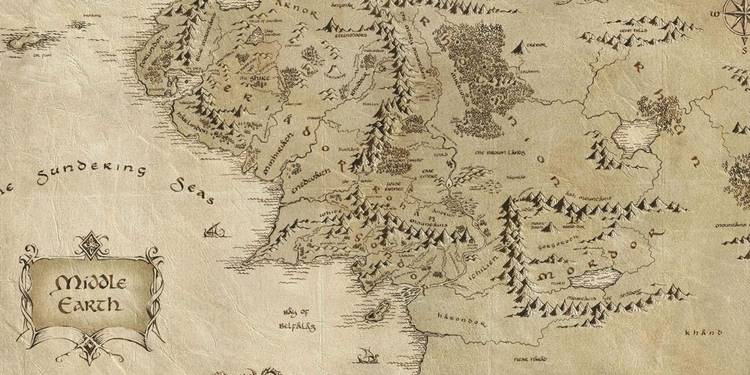
The Lord of the Rings: The Rings of Power had its fair share of detractors, but there was one aspect that no one could hate on: the beautiful and evocative settings. Season 1 introduced fans to the Elven cities of Lindon and Eregion. The pair of cities perfectly embodied the regality of the Eldar. Likewise, Khazad-dûm personified the pomp and brashness of Dwarvish society. Finally, Númenor shown with a splendor that foreshadowed Minas Tirith from The Lord of the Rings.
The Rings of Power's last setting was the Southlands. It wasn't an exciting place, but it was the location of Season 1's most consequential storyline: the creation of Mordor. In "Udûn," Adar's plan came to fruition. Using a magic sword, he ignited Mount Doom, destroying the Southlands and creating Mordor in one fell swoop. The creation of the evil realm left a lot of people without a home. Thus, Bronwyn decided relocate the Southlanders the city of Pelargir. Here's why that location is important in the LOTR universe.
Multiple Lord of the Rings Fights Took Place in Pelargir
Pelargir was a pretty important city in The Lord of the Rings. It was one of the earliest Númenórean settlements in Middle-earth, but over time, it became a place of refuge. Many of the Faithful went to Pelargir to escape persecution from the King's Men. When it was built, it was a port city at the mouth of the Anduin River. However, the catastrophic destruction of Númenor changed the coastline, which meant that Pelargir was 50 miles inland by LOTR's time period.
Even inland, Pelargir remained an important city. As Gondor's strength grew, Pelargir was its chief port, and under the Ship-kings, Pelargir became the home of Gondor's navy. Over time, Pelargir became weaker because of repeated attacks by the Corsairs of Umbar. An attack even killed one of Gondor's kings. Luckily, all of that ended in The Return of the King, when Aragorn, Legolas and Gimli arrived at Pelargir. They had the Army of the Dead in-tow, which allowed the trio of heroes to liberate the city and commandeer the Corsair's ships.
Why Pelargir Will Be Important in The Rings of Power
If The Rings of Power follows LOTR canon, Pelargir will be important to the series. Moving there represents a new beginning for the Southlanders. Some of their ancestors had served Morgoth, and after the war, the Elves had watched everyone condescendingly. Unfortunately, there wasn't a good way to separate the evildoers from the innocents. But after the creation of Mordor, everything has become clear: anyone that stays in Mordor, serves Sauron, while everyone that moves to Pelargir does not.
Pelargir will also be the setting for Isildur's story. When Season 1 ended, everyone in-story assumed that he was dead, but fans knew that the future king was alive somewhere. Because the Númenóreans left him in the Southlands, it makes sense that he will have to fight his way back to Númenor, and going through Pelargir is the only way to do that. It will be interesting to see how Isildur survived the creation of Mordor and what he's been up to since then.
On another note, Pelargir will also be the setting for most of Bronwyn and Arondir's story. They made a great pair last season. So, having them back for Season 2 will ensure The Rings of Power's best relationship is maintained. All of those different plots run through the city of Pelargir, so it will clearly be a significant setting in Season 2.
The Rings of Power Season 1 is streaming now on Prim Video. Season 2 does not have a release date.
Editor's Note: The following article contains spoilers for Episodes 1-4 in The Rings of Power.
Prime Video’s long-awaited series Lord of The Rings: The Rings of Power, the latest project to borrow from J.R.R Tolkien’s well-loved Middle-earth, has taken the audience by storm. With well-executed references to canonical events, along with quite a number of backstories for events Tolkien’s ardent fans may be well-versed in, the series almost stands as an unofficial prequel of sorts.
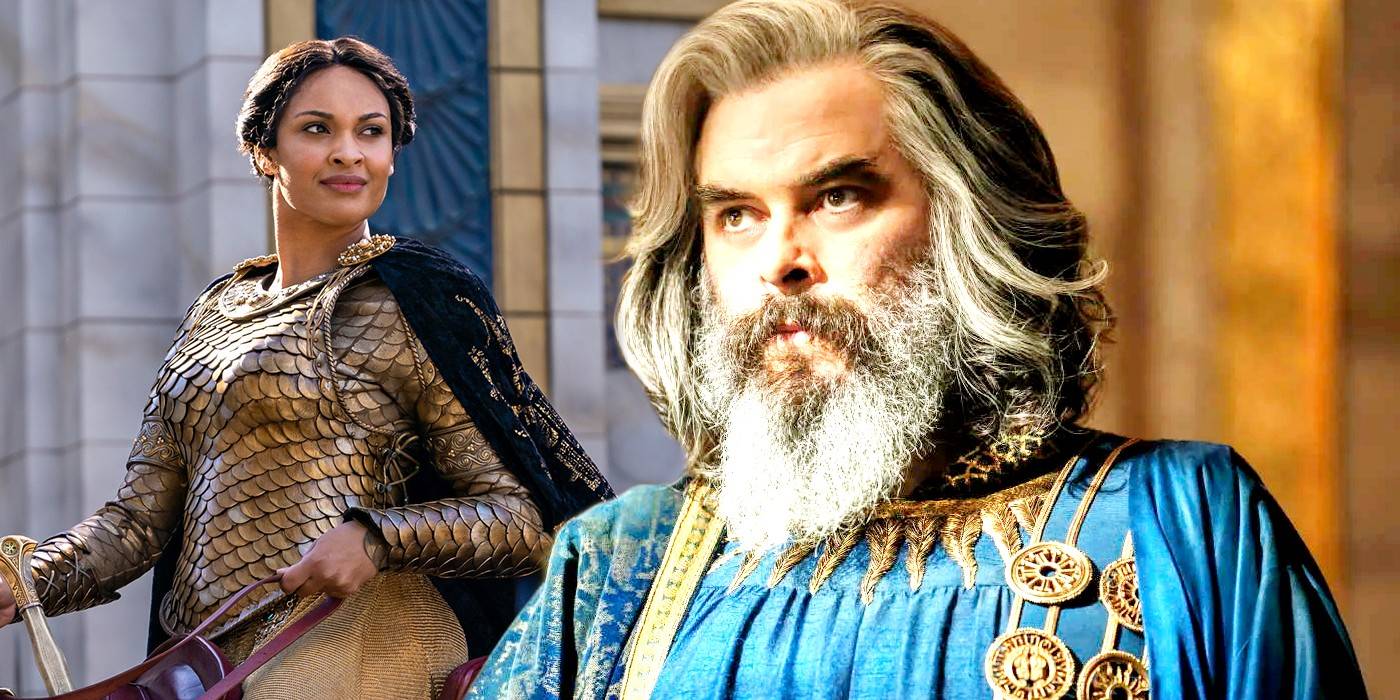
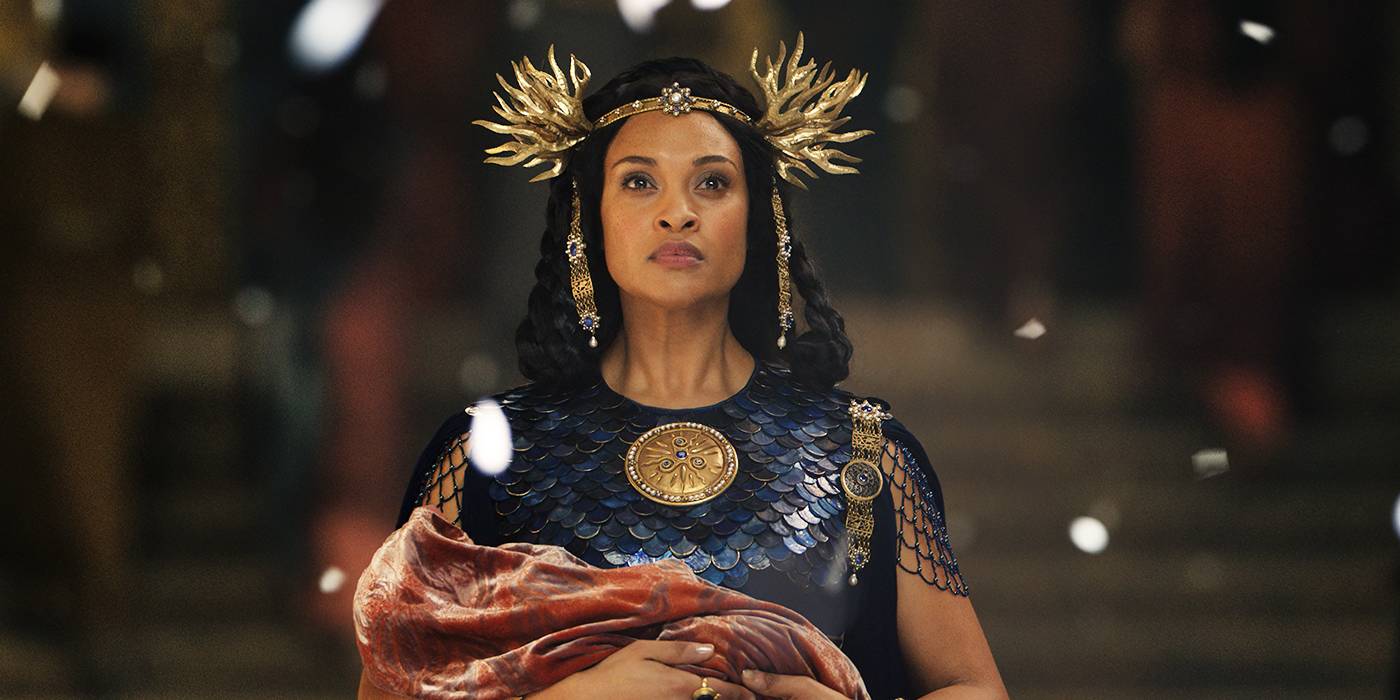
The show’s latest episode, "The Great Wave", shines light on Queen Regent Miriel (Cynthia Addai-Robinson) and her father Tar-Palantir’s knowledge of the prophecy regarding the doom of Númenor. According to the Queen, the prophecy would be set in motion upon an elf’s arrival — a rather explicit hinting towards Galadriel (Morfydd Clark) — and the source of this futuristic bit of information is none other than — a palantir!
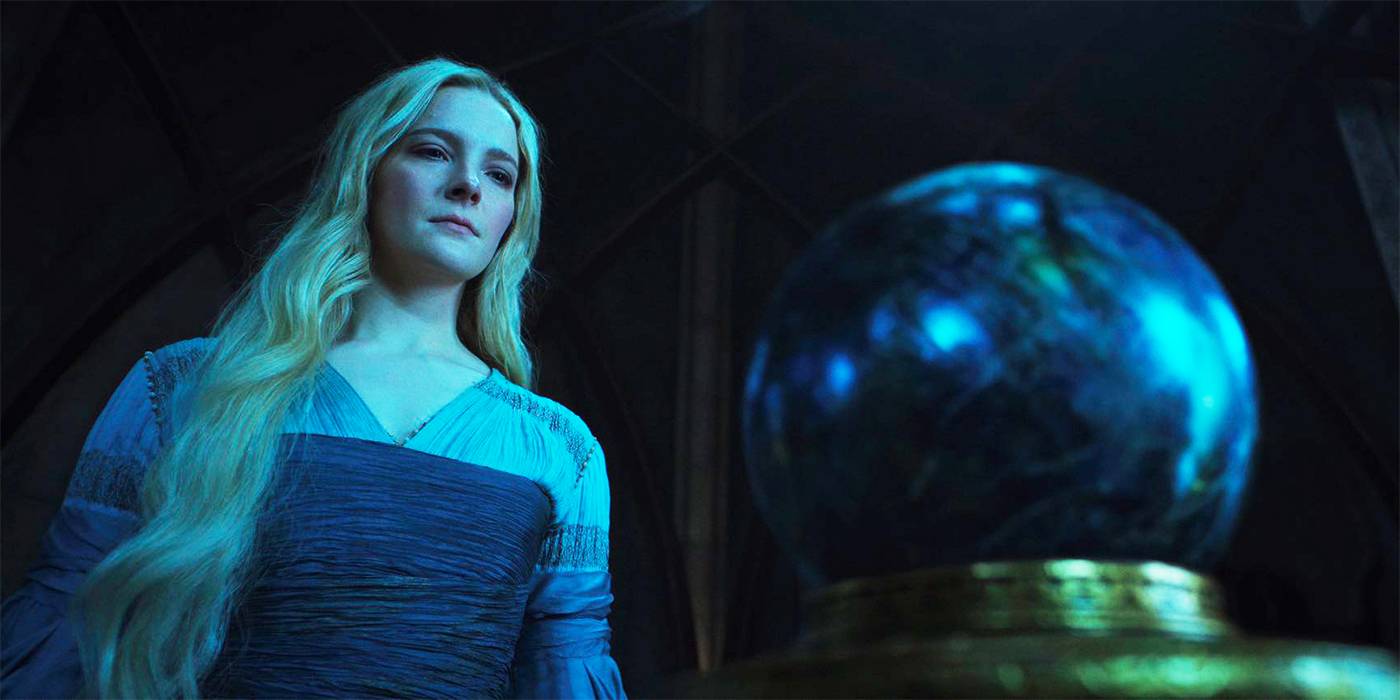
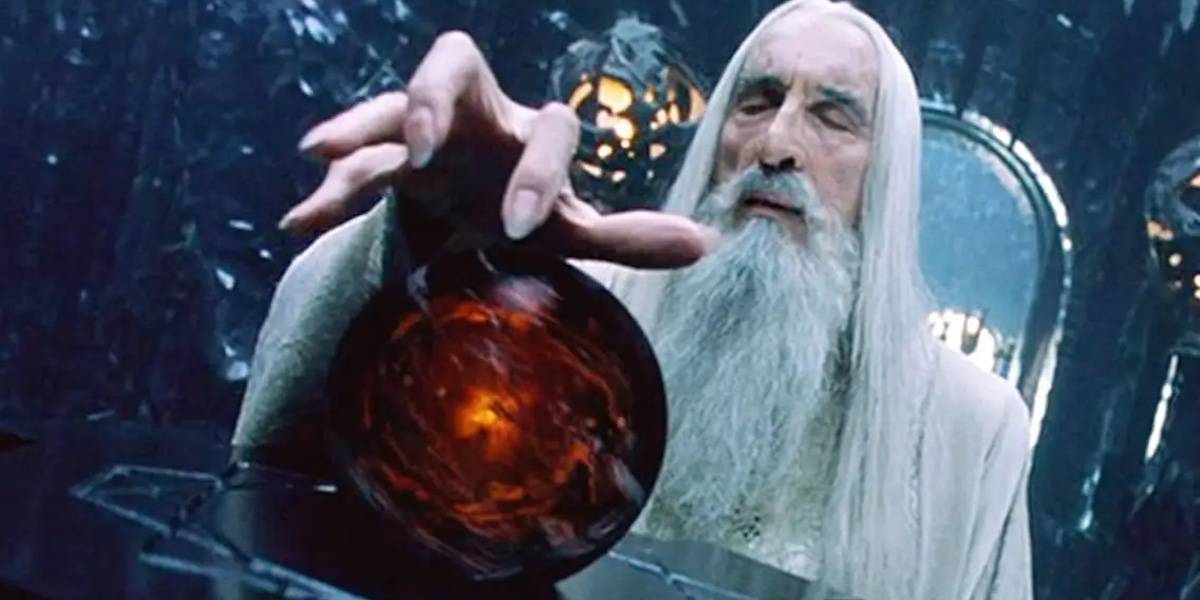
Ardent fans of Tolkiens’ works are no stranger to the spherical crystals called palantiri (plural for palantir), objects of great power holding the ability to let their master glimpse beyond their own realm of time. Translated to “far-sighted” in Quenya, —the language of the Elves — the palantiri have remained instrumental in aiding the events of The Lord of the Rings — and now that The Rings of Power has introduced its own spin on the unbreakable Seeing Stones, their hype has never been realer! With that being established, here is all that we know about the crystal balls.
What Is the Significance of the Palantiri in Middle-Earth?
Created by Tolkien as the Seven Stones, to go with the well-known Seven Stars symbol commonly believed by the Elves as a signal to the downfall of Morgoth, the palantiri allude to the genius of the great author, and his attention down to the minutest of details, in birthing the vast fantasy world spanning over millennia.
Canonically speaking, the indestructibly mighty palantiri are believed to be created by the Elves of Valinor during the First Age, and by the time the events of The Lord of The Rings start to roll around, somewhere during the Third Age, only a handful haven’t already fallen victim to time’s wear and tear— a fact that continues to stand in Peter Jackson’s film trilogy of the same name.
How Do Palantiri Work?
In Tolkien's writing, although a vast number of palantiri were created, the great Elendil, following the destruction of Númenor, carries only seven to Middle-earth — namely the Osgilath stone; the largest and chief among all; the Annuminas-stone, placed in a city of the same name; the Itnil-stone, later channeled by Sauron; the Orthanc stone, a cause for the wizard Saruman’s ultimate downfall; the Anor-stone, held by Denethor as he takes his own life; the Amon Sul-stone, unable to be lifted ‘by one man alone’; and finally the Elostirian stone, uniquely lacking in its ability to communicate with the other stones.
It is understood that a palantir harbors the dual ability to let one communicate with another wielder of the stone, as well as look back/glimpse ahead into time, but there’s quite an interesting bit of twist in the tale! The palantiri respond to their master’s power, and should their channelers be knowledgeable enough as to place the great object in the most favorable spots — the stones are not known to do well in darkness, for instance — they could potentially look into any part of the world!
Additionally, although the palantiri cannot technically ‘lie’ in terms of upcoming or previous events, those with corrupt intentions can quite easily use them to present half-truths by concealing the context and a deliberate chunk of the story; thus setting off chaotic events throughout the timeline. In fact, in several instances, deceptive or otherwise, the palantiri have indeed shaped Middle-earth into what it is today.
The Palantiri Is Often Used for Evil
The antagonist Sauron, uses the palantiri to his own advantage on several occasions, influencing the visions they are showing others. The Dark Lord is well aware that some palantiri are lost, and puts that bit of knowledge to personal gain, warping the stones’ produced images to monitor and weaken his opposition. At one point, he is able to influence Saruman, instructing him to build an army “worthy of Mordor” once completely in control of the being. On a separate occasion, his altered visions to Denethor cause the latter to believe all is lost, thus leading the man to take his own life.
In The Two Towers, when Pippin, upon having had a taste of the power of the crystal, steals it from a sleeping Gandalf, his peeking into it sets off a plethora of wrongful assumptions and half-assessments by Sauron, looking through his own seeing stone. Knowing that the One Ring is in the hands of a hobbit, Sauron assumes the hobbit in question is none other than Pippin himself — and that he’s been captured by Saruman. The Ring, therefore, being as good as Sauron’s, who has been working alongside him.
Consequently, the instance of Aragorn looking into Saruman’s palantir has the peeking Sauron believe that the ranger has been defeated, with the ring and palantir stolen, when that could not have been farther from the truth, since the ring is being held by Frodo. The courageous Aragorn challenges Sauron in a battle of wills, rousing him by virtually presenting to him the Sword of Elendil, the sword that first defeated Sauron's physical form. Understandably not one to be up for such humiliation for a second time, Sauron goes after Aragorn, retrieving his forces from Mordor and allowing Frodo easy access, while unknowingly turning his back on a war he could easily have emerged victorious in. In many ways, then, his second defeat is relatively more humiliating.
Over time, the palantiri have proved to be a tool most helpful, if rather consequent, in their deceptiveness. But, what is most interesting is the fact that being one of the vital, almost to the point of being sacred, parts of Tolkien's lore, they have made their official entrance into The Rings of Power, which is sure to make any fan's mind run wild on what their further role will be in the series.
Warning: spoilers ahead for The Rings of Power episode 4
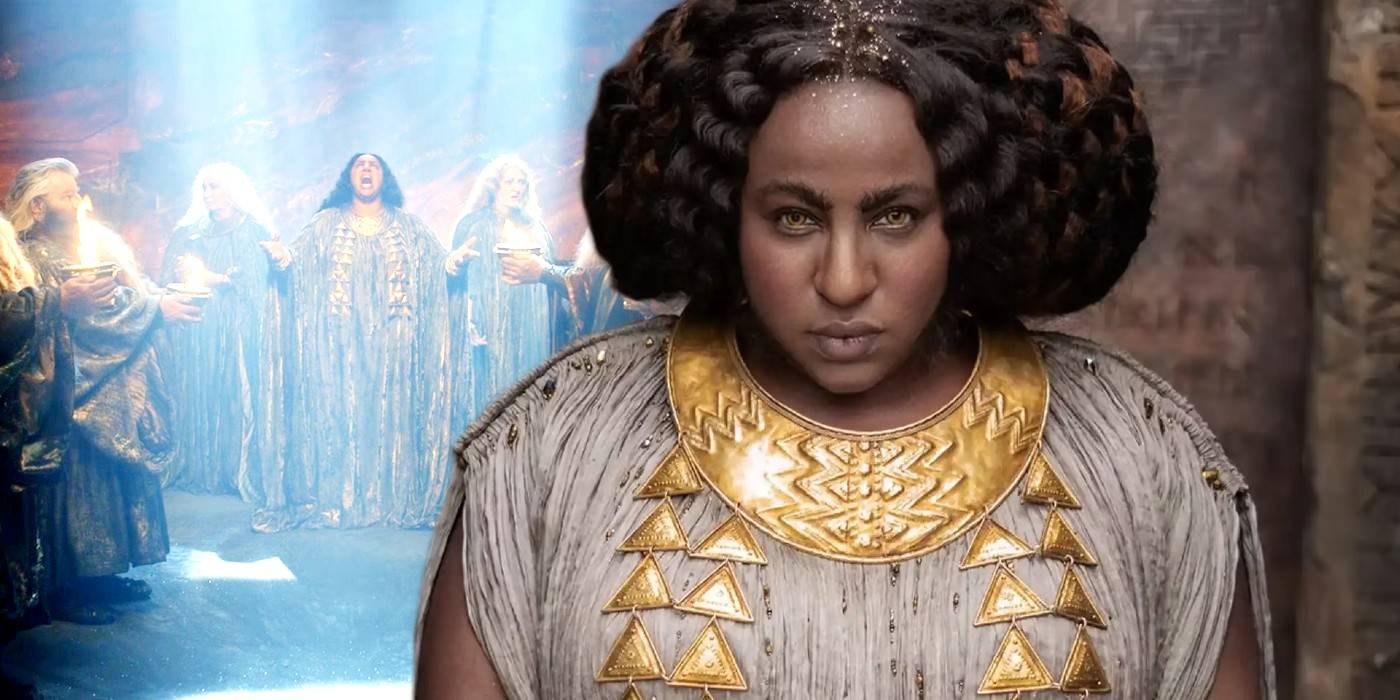
Does Disa's melancholic musical mountain tribute save Moria's trapped miners in The Lord of the Rings: The Rings of Power episode 4? Just as Durin IV and Elrond are mending their friendship, disaster strikes deep in the bowels of Khazad-dûm. While undertaking the risky process of excavating mithril from the mountainous rock, a group of miners gets caught in a collapse. As Moria desperately and sadly hopes for the best, Elrond watches Disa, Durin IV's wife, sing a hauntingly beautiful melody accompanied by a droning dwarf choir.
Durin IV already revealed the extent of Disa's powerful voice, telling Elrond in their The Rings of Power episode 4 heart-to-heart how his wife's harmonic humming discovered mithril in the first place. Dwarves use the resonance of their booming voices to detect where mineral lodes are located within the mountain. What Disa may describe as the mountain singing back is actually a rudimentary sonar system, using sound waves to measure unseen structures behind Moria's rock. Disa obviously isn't hunting for mithril while the miners are missing though, so what's the song in The Rings of Power episode 4 for?
Disa tells Elrond that her song is a "plea" for the mountain to release Moria's lost miners. There's a ritualistic, prayer-like quality to The Rings of Power's impromptu vocal performance, and this fits J.R.R. Tolkien's depiction of dwarf culture, where mountains and mining is essentially a religion. But The Rings of Power suggests there's more to Disa's song than just hope and prayer. Elrond is shocked to witness wet sediment moving unnaturally across the rock, strangely parting in two separate directions in response to Disa's vocal gymnastics. The Rings of Power hints that Disa's song actually shifts Moria's stones and, sure enough, the trapped miners are freed shortly after. Did Disa's music move the rocks that imprisoned them? The Rings of Power keeps its secrets, but that's the implication.
Disa's Singing Can Explain The Lord Of The Rings' Balrog
Moria is a thriving community in the Second Age when The Rings of Power is set, but cuts a less delightful image in The Lord of the Rings after the Balrog sleeping at Moria's bottom wakes up grumpy. Gandalf explains that the Dwarves' greed pushed them to mine deeper and deeper in search of mithril, and reveals it was these efforts that stirred Durin's Bane from its peaceful slumber. But if Dwarves use their singers' resonating voices to detect where mithril can be mined in Moria, that same sonar music would've surely picked up the massive fire demon waiting to smite them. Perhaps, therefore, it wasn't the mining that awoke Moria's Balrog, but the voices of singers like Disa trying to find the next payload of mithril.
The Rings of Power actually teased this possibility already. As early as episode 1, Disa told Elrond about how she sings to the mountain, ominously adding, "And where to leave the mountain untouched..." The line implies that Disa has sensed something dark within Moria's pits - potentially the Balrog's distant snores. Disa may be skilled enough to these avoid suspect areas, but future generations of singers more desperate to find mithril resources in the Third Age may not take as much caution as Durin IV's singing spouse...
Amazon’s much-awaited show The Rings Of Power was released on 2nd September. Upon release, The Rings Of Power received positive reviews from critics and fans.
So far, here is 3 episodes of The Rings Of Power season 1 has released. The 2 episodes of The Rings Of Power were released together on 2nd September and 3rd episode on 9th of september. Here’s looking at the release time of episode 4 of The Rings Of Power in Australia.
The Rings Of Power Season 1 Episode 4 Release Time in Australia
The release time of The Rings Of Power S1E3 from Australia’s Western Standard Time to Eastern Standard Time is:
The Rings Of Power Episode 4 Release Time in AWST
The 4rd episode of The Rings Of Power will release at 03:00 PM on the 16th of September according to the Australian Western Standard Time (AWST).
The Rings Of Power Episode 4 Release Time in ACST
The 3rd episode of The Rings Of Power will release at 04:30 PM on the 16th of September according to the Australian Central Standard Time (ACST).
The Rings Of Power Episode 4 Release Time in AEST
The 3rd episode of The Rings Of Power will release at 05:00 PM on the 16th of September according to the Australian Eastern Standard Time (AEST).
Where to watch The Rings Of Power Episode 4 in Australia?
In Australia, you can watch The Rings Of Fire only on Amazon Prime Video. As The Rings Of Power is an Amazon original series, it gets released only on Prime Video platform in the app and website.
“The past is dead,” Elendil (Lloyd Owen) lectures his children. For many of the characters in Episode 3 of Prime Video’s The Lord of the Rings: The Rings of Power, “Adar,” the only way out is through, leaving the past where it lies. Familiar characters meet new ones on unfamiliar shores, friends are reunited in circumstances both dire and hopeful, and alliances are cemented. Amid (literally) visceral action and production design that earns every inch of the show’s most-expensive-ever bona fides, this episode is all about moving forward — through trial, against hardship, beyond the past — for better or for worse.
A barely-conscious Arondir (Ismael Cruz Cordova), last seen being yanked through an underground curtain of roots, is dragged through dirt-walled passages teeming with skull-clad orcs and their captive humans. With an orc hiss of “for Adar,” Arondir is chained and tossed into a group of human prisoners who are digging a passageway, exposed tree roots reaching out to them like orc fingers, caging them like gnarled bars. He is helped up by another elf — Arondir’s cheeky patrol buddy Médhor (Augustus Prew) and the watch warden Revion (Simon Merrells) are captives here too.
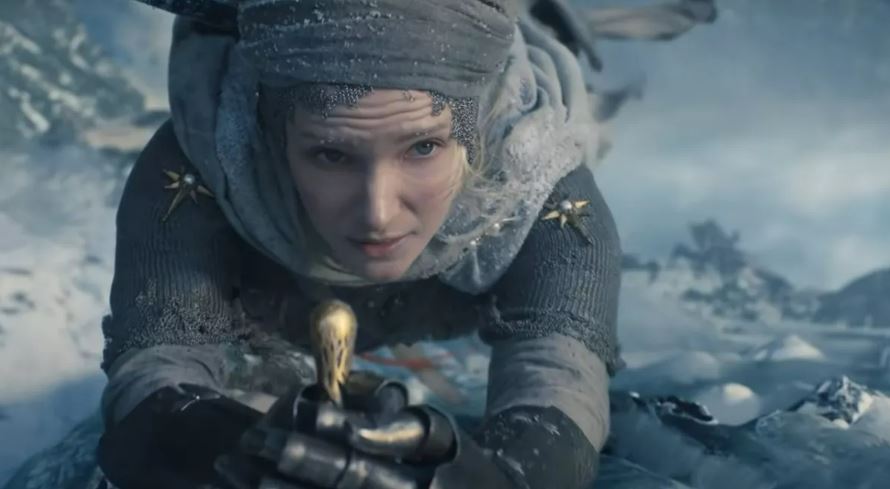
As screams of prisoners echo in Arondir’s ears, Galadriel (Morfydd Clark) awakens in the belly of a ship as if from a nightmare. “Saviors or captors?” she asks Halbrand (Charlie Vickers). When they emerge onto the deck, the answer remains unclear. Their captain, presumably the caped silhouette from last week’s cliffhanger, is taking them to his home for guidance — and he’s wearing Galadriel’s blade. As Halbrand marvels at the waterfalls and carved giants of this new land (same, Halbrand, same), Galadriel has pieced it together: They are in “the land of the star, the westernmost of the all mortal realms, the island kingdom of Númenor.” The boat lowers its sails like wings as it passes through an arch into port, all white-washed buildings, climbing trees, and sea blue. It’s a breathtaking new location, putting those many Amazon dollars to work.
Galadriel tells Halbrand that these people fought on the side of the elves, who rewarded them with the island. But Númenor broke that relationship, and elves have been unwelcome ever since. This is made abundantly clear by their hostile reception from Queen Regent Míriel (Cynthia Addai-Robinson), clad in shimmering jewel-toned scales like a fish from Númenor’s waters. Galadriel, so good with a sword but so bad with diplomacy, demands a ship to Middle Earth, immediately pulling the “Elves gave you this island” card. It takes Halbrand’s surprisingly smooth tongue to defuse the situation. The “companions by chance” will be Númenor’s “guests” while the queen weighs the request. Before they are escorted away, Halbrand gives Galadriel her blade, swiped from the captain. His list of skills grows longer.
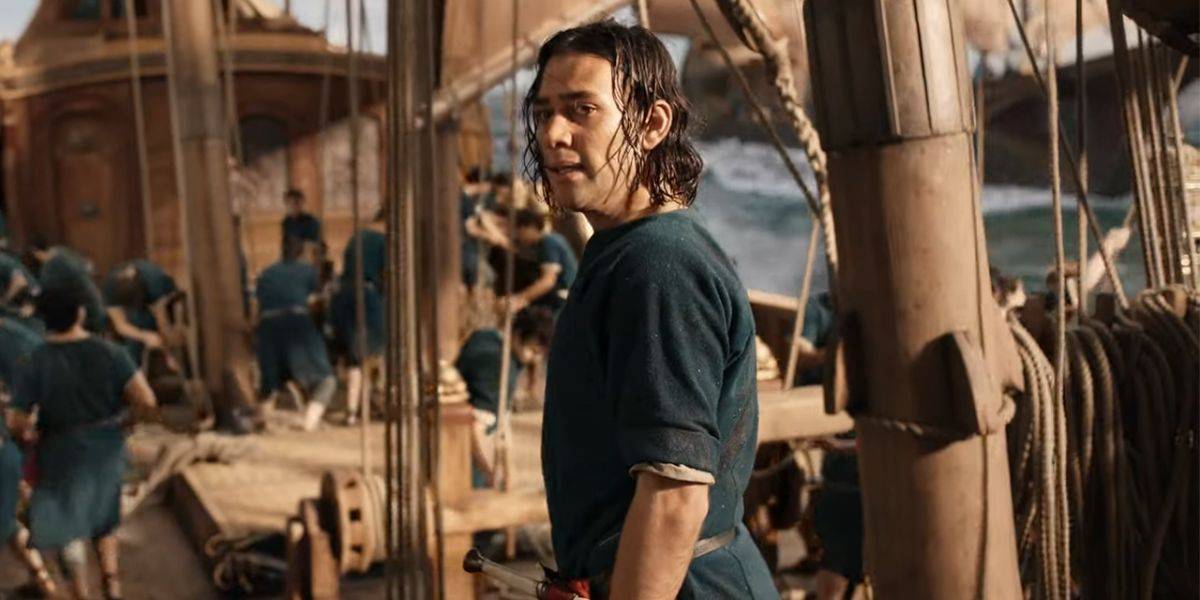
Meanwhile, Míriel asks her luxuriously coiffed advisor Pharazôn (Trystan Gravelle) about the captain who brought the unwelcome pair ashore. He is Elendil, a guard of noble blood, who has a son, Isildur (Maxim Baldry). These names will be familiar to book or movie fans; I’ll avoid spoilers by not saying why. Isildur is part of a crew of cadets, working to become a member of the Sea Guard. It’s just nine days before the Sea Trial, but this may not be the life he wants to (ahem) dive into. Elendil’s name means "one who loves the stars," but the queen knows it also means “elf-friend,” and she wants to know which meaning is truest for him. To test his loyalty, she asks him to perform a mysterious service.
We fly east across the Sundering Seas to Middle-earth. Númenor’s sun-soaked beauty is traded for the pillaged Southlands, where Arondir, caked in grime and blood, learns that the orcs are ransacking villages, looking for something for their revered leader “Adar”; the captive elves wonder if this Elvish word is one of Sauron’s many names. Has Morgoth’s disciple returned at last? The elves hatch a plan to escape, but before they can enact it, Revion defies the order to tear down an ancient tree. His company is given water in return for his show of strength — but some terrible game is clearly afoot. When Médhor drinks deeply, an orc strikes with whip-crack speed, slashing his upraised throat. The orcs laugh as Médhor collapses, still drinking before he realizes he’s already dead. Arondir takes an ax and climbs up the roots, which now stretch into the pit like pleading arms, and gets a view over the trench to the no-man’s-land devastation above: trees uprooted, grass scorched away, smoke rising from the barrenness. He touches the bark, speaks what sounds like an apology, then begins to chop.
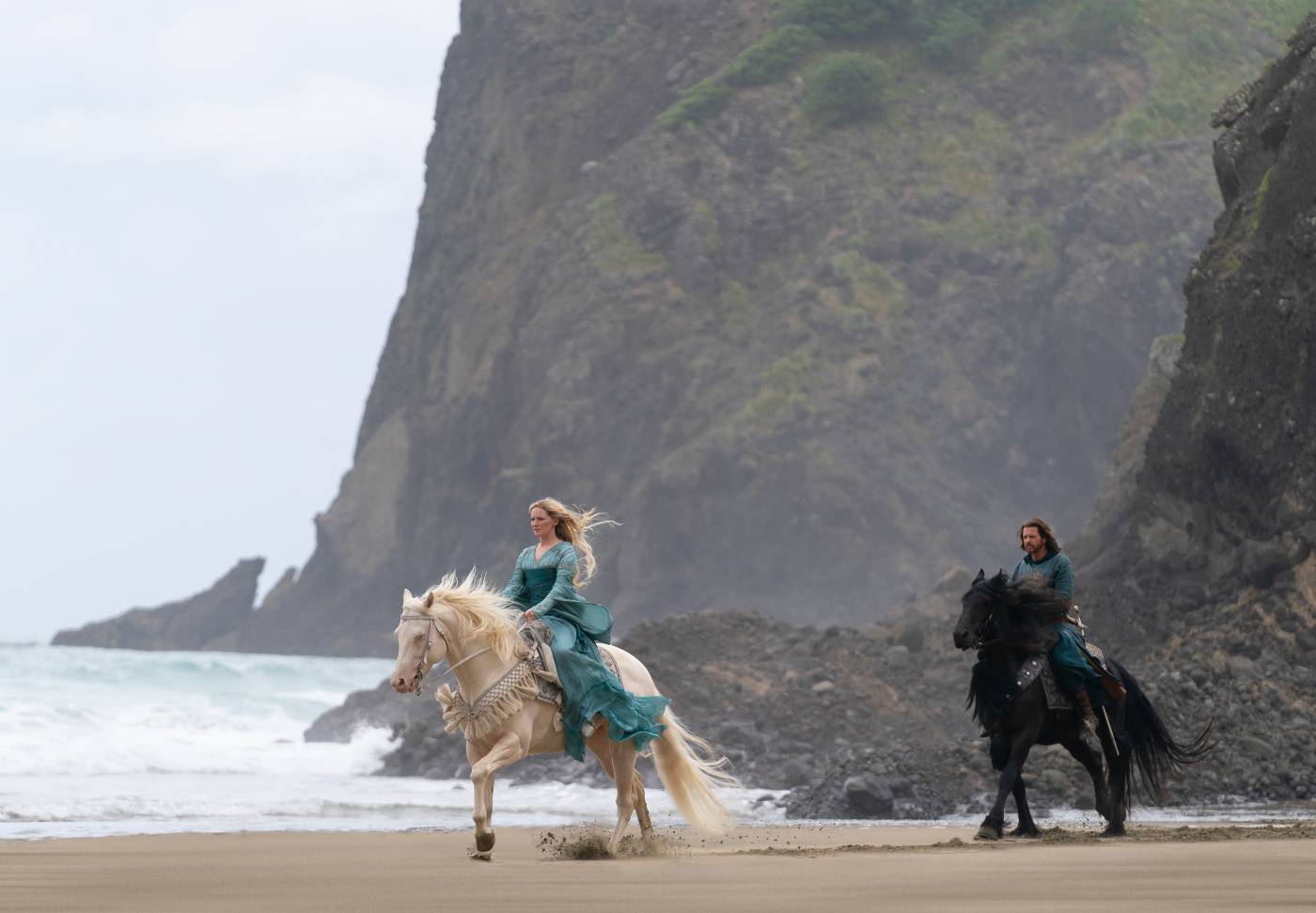
Back to Númenor, where Galadriel, dressed in the flowing ocean blue of the Númenor people, her ears carefully concealed, flits above the guards from roof to roof, eyeing a boat. From the shadows, Elendil stops her — he has been charged with watching her. Galadriel would like him to shut up now, thank you very much, but when he speaks in Elvish, her attention is turned; where he’s from, on the western shores, it’s still taught. When next we see them, they are riding through a wide plain and along the sea. Galadriel is smiling unguardedly for the very first time, her hair and dress rippling behind her like the waves they gallop alongside.
Halbrand wants a fresh start as a smith, but he can’t have a job unless he earns a guild crest. He finds his mark in a tavern and steals a crest from a mouthy bully. But the mark and his crew follow Halbrand into an alley and knock him flat with two punches. Just when they and we think he’s done for, Halbrand jumps screaming to his feet and single-handedly takes out all four attackers, including breaking one’s arm in closeup — the captions said “[screaming]” and so did I. But even he has limits — namely, the tips of the spears from the approaching guards. Who is this mystery Southlander and what else is he capable of?
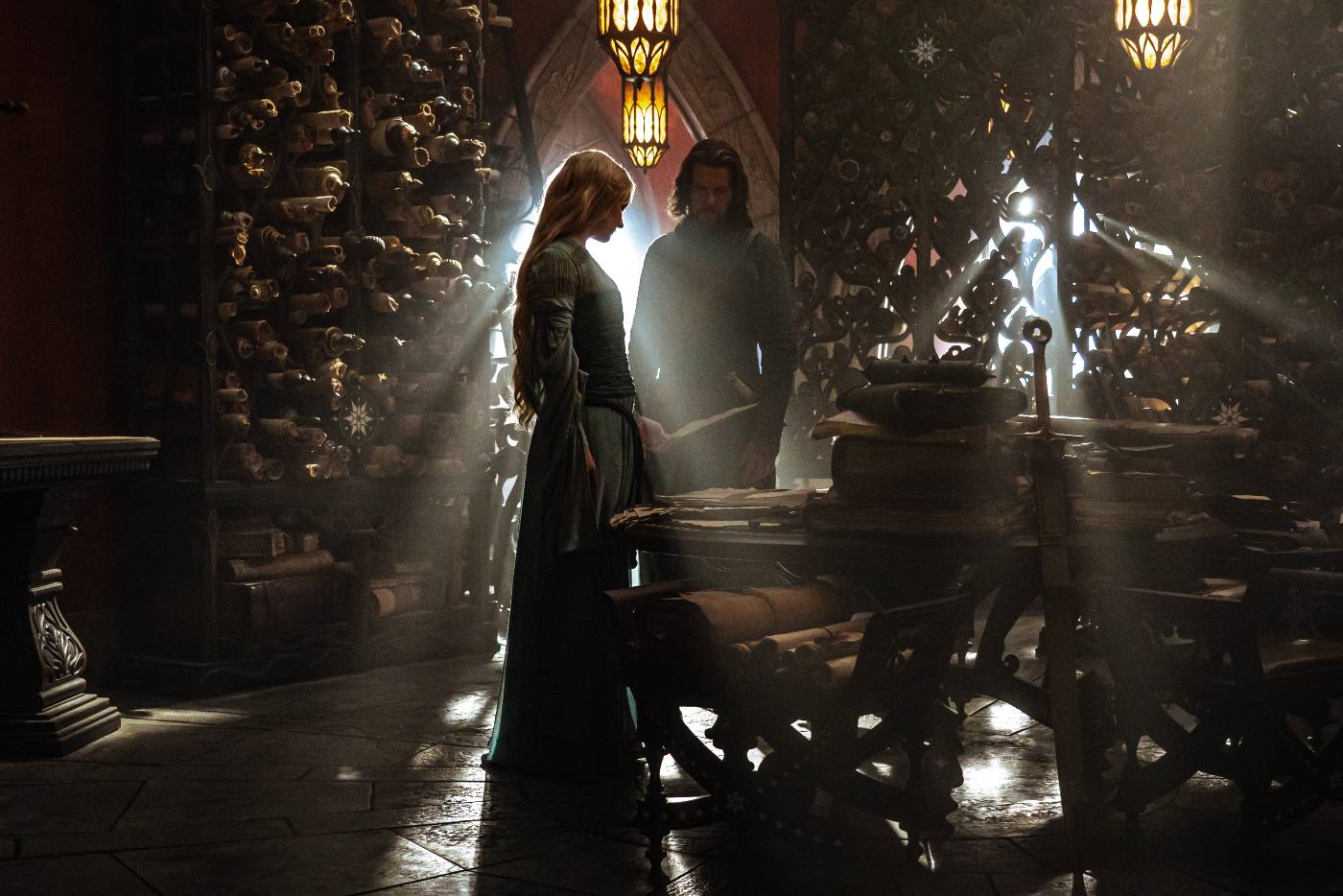
Galadriel and Elendil arrive at the Hall of Lore, a library piled high with scrolls. The last king kept it from being torn down, and was forced from the throne for his loyalty to the elves, “an exile in his own kingdom.” The materials pulled for her include Sauron’s sigil, as drawn by an escapee from a dungeon. Galadriel suddenly understands: it’s not a sigil, but a map of the Southlands. Morgoth planned to create a land where evil would thrive in case he was defeated, to be built by his successor — Sauron. “If Sauron has indeed returned,” Galadriel warns, “the Southlands are but the beginning.” That’s two portentous references to Sauron’s return, for those keeping score.
Need a break from the doom and gloom? The Harfoots are dancing through a dense and sun-dappled Middle-earth forest, costumed as fanged animals or crowned with grass-and-ivy headdresses. Sadoc (Lenny Henry) leads the merry march and a chant of “nobody goes off trail, and nobody walks alone.” But Marigold (Sara Zwangobani) isn’t so sure. She fears they’ll be left behind because Largo’s (Dylan Smith) foot hasn’t healed. He is relying on Nori’s (Markella Kavenagh) persistence to keep them on course. Right on cue, she pops out of hiding elsewhere in the camp, absolutely plotting mischief. She wants to look through Sadoc’s book for her meteor-man friend’s stars. “There’s head-sense, Poppy, and there’s heart-sense,” Nori pleads. “There’s common sense and there’s nonsense,” Poppy (Megan Richards) replies. But when Nori blackmails Poppy with the knowledge that she put fireweed in Malva’s toe cream (ow and ew), Poppy distracts Sadoc so that Nori can get her hands on the star chart. Full carts, fuller bellies, can’t lose.
At the festival, Sadoc honors those from prior migrations “who fell behind.” “In life, we could not wait for them, but here now, we welcome them to our circle,” he says, and each lost Harfoot’s name is greeted with a chorus of “we wait for you.” Among the roll are five Proudfellows, taken by landslide, intoned as Poppy Proudfellow sits alone, eyes wet for the family she couldn’t wait for. The Stranger (David Weyman) sneaks into camp and takes the star chart to an untended fire. By its light, he finds the lights he seeks: the stars of his constellation. But the festival fires begin to pulse, and the chart begins burning. The Stranger panics, crashing about the half-his-size camp, calling for Nori, who is now in deep trouble. Nori is defiant: “Without friends, what are we surviving for?,” she asks. “Heaven forbid we explore something new for once.” Sadoc won’t decaravan the family, but their cart will travel at the back of the line.
Back in Númenor, Elendil and his children catch up about the eventful day in a fire-bright courtyard. But Galadriel isn’t the only topic of discussion: As his far-off looks implied, Isildur wants to defer his sea trial. Elendil is not pleased; he wants his son to look forward, not back: “The past is dead. We either move forward or we die with it.”
In the prettiest dungeon this side of the Sundering Seas, Halbrand is grappling with the same choice. Galadriel visits to show him something else she found in the Hall of Lore — the winged symbol on the pouch around his neck. A man under that mark united the Southlands ages ago; might that same banner unite the Southlands against Sauron? “Your people have no king, for you are him,” Galadriel reveals. “The armor that ought to rest upon your shoulders weighs upon your soul.” Move forward, Halbrand, she seems to say. Past need not be prologue. While Halbrand’s family sided with Morgoth and lost the war, Galadriel’s people started it; she thinks that this pair of self-exiles can redeem their bloodlines if they go to Middle-earth, together. But it might not be so simple to leave. High above the sea of Númenor’s glowing lights, Míriel visits her deposed father. “It is here, father. The moment we have feared. The Elf has arrived.”
Back in Middle-earth, the camouflaged Harfoot migration caravan rolls along. Poppy carries her cart alone, while Largo struggles with the Brandyfoots; they may all fall behind. But then the cart starts to shake, and the Stranger emerges from behind it. “Friend,” he says simply before beginning to push the cart along the long trail. Nobody goes off trail, and nobody walks alone, because without friends, what are we surviving for?
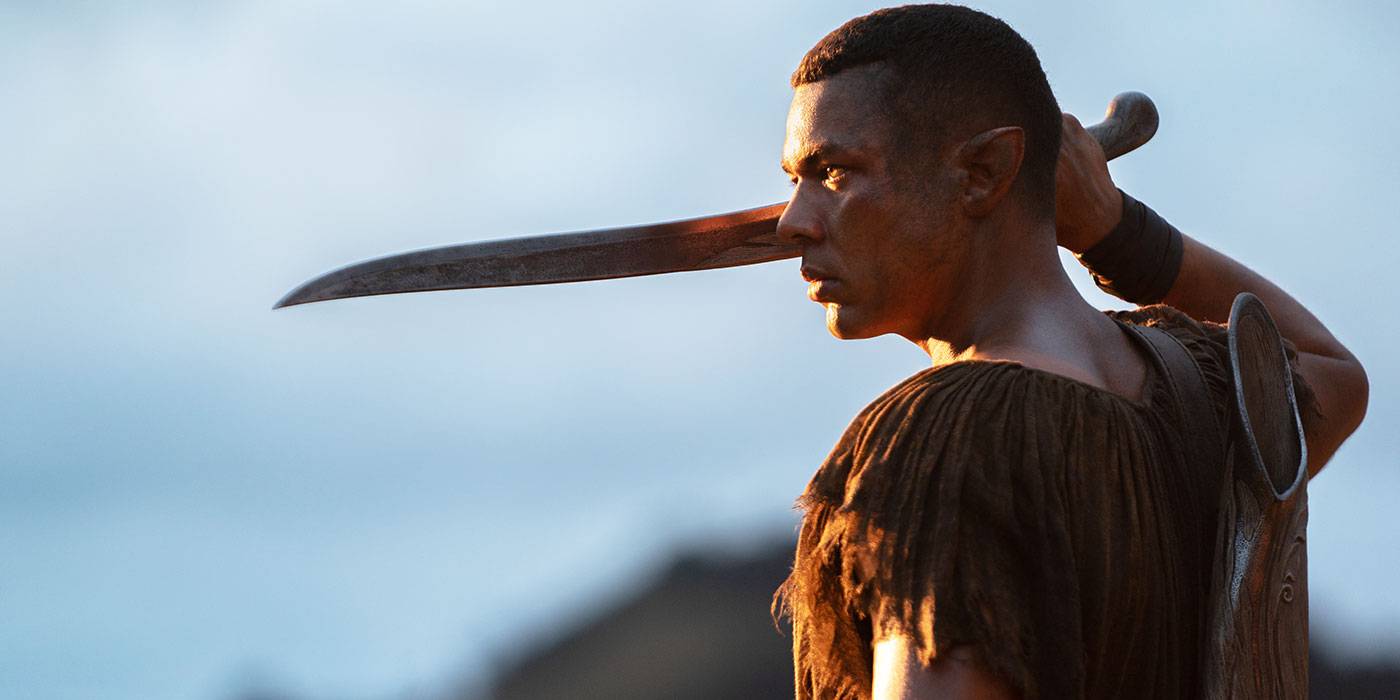
Friends are all Arondir has back in the orc pit, where rebellion has exploded. Revion and Arondir kick their chains into orc faces, and during a deadly game of tug-of-war, Arondir runs nimbly across the taut chains, leaping off them to take down the ragged sun shelter with one blow, exposing the orcs to the skin-searing sun. “Release the warg,” an orc commands, and a snarling part-dog, part-boar, all-fang creature promptly rips out the guts of two prisoners before Arondir binds it. The felled tree offers its jagged roots up to him: as he is yanked backward, he sinks one into the leader’s throat. Revion frees his own chains and takes off for home. But as Arondir claws his way over the trench, Revion is standing stock still. Is he astonished at his freedom? Immobilized by the ravaged landscape? No — he is struck with an arrow. As Revion falls to the earth he’ll now rejoin, Arondir is pulled screaming back underground. He is saved from certain death for a fate that may be much worse — “bring him to Adar,” snarls an orc.
A sea of skull-helmeted orcs parts for a figure that looks more human than orc, wearing a familiar clawed glove on his left hand. Is this the big bad we, and the elves, have been waiting for? Just as he’s about to come into focus, we cut to black. The show sure knows its way around a “who’s this guy now???” cliffhanger!
The Lord of the Rings: The Rings of Power premieres new episodes weekly every Friday on Prime Video.
Warning: Contains SPOILERS for The Lord of the Rings: The Rings of Power episode 3
The Lord of the Rings: The Rings of Power episode 3 is now available on Amazon Prime, and with it comes a whole batch of new characters and actors for the series. The first two episodes of the show established what is likely to be the main cast of characters, from Galadriel, Arondil, and Elrond of the elves to Durin of the dwarves and Halbrand and Bronwyn of the humans. However, as the show's cast can certainly be described as a massive ensemble, these are but a few of The Rings of Power's cast members, with even more being introduced in the third episode.
The Rings of Power episode 3 continues where the second left off, with Galadriel and Halbrand aboard the boat that found them adrift at sea. This boat is revealed to belong to Númenor, the kingdom founded by the Men of Edain who assisted the elves of Valinor in the War of Wrath at the end of the First Age. Meanwhile, Arondil finds himself enslaved by orcs in the Southlands and forced to dig tunnels beneath the ground, as Nori Brandyfoot and her family continue to deal with the stranger who fell from the sky in The Rings of Power episode 1.
It is in the first two of these subplots that the major new additions to The Rings of Power come in terms of cast members and their respective characters. Namely, it is predominantly through the kingdom of Númenor wherein The Rings of Power's new characters are introduced that will undoubtedly affect the series itself and Middle-earth's futures. That being said, some other characters are introduced outside the kingdom of men, and here is a comprehensive list of every new character and actor in The Lord of the Rings: The Rings of Power episode 3.
Elendil - Lloyd Owen
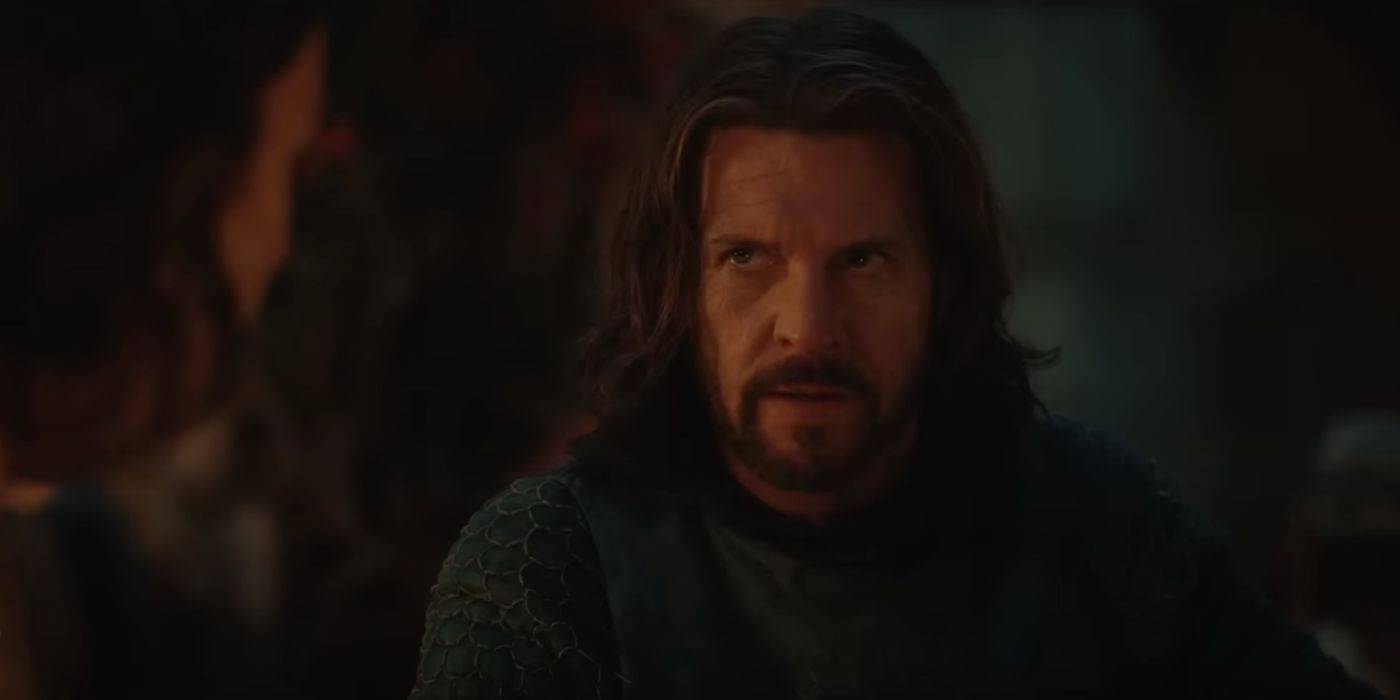
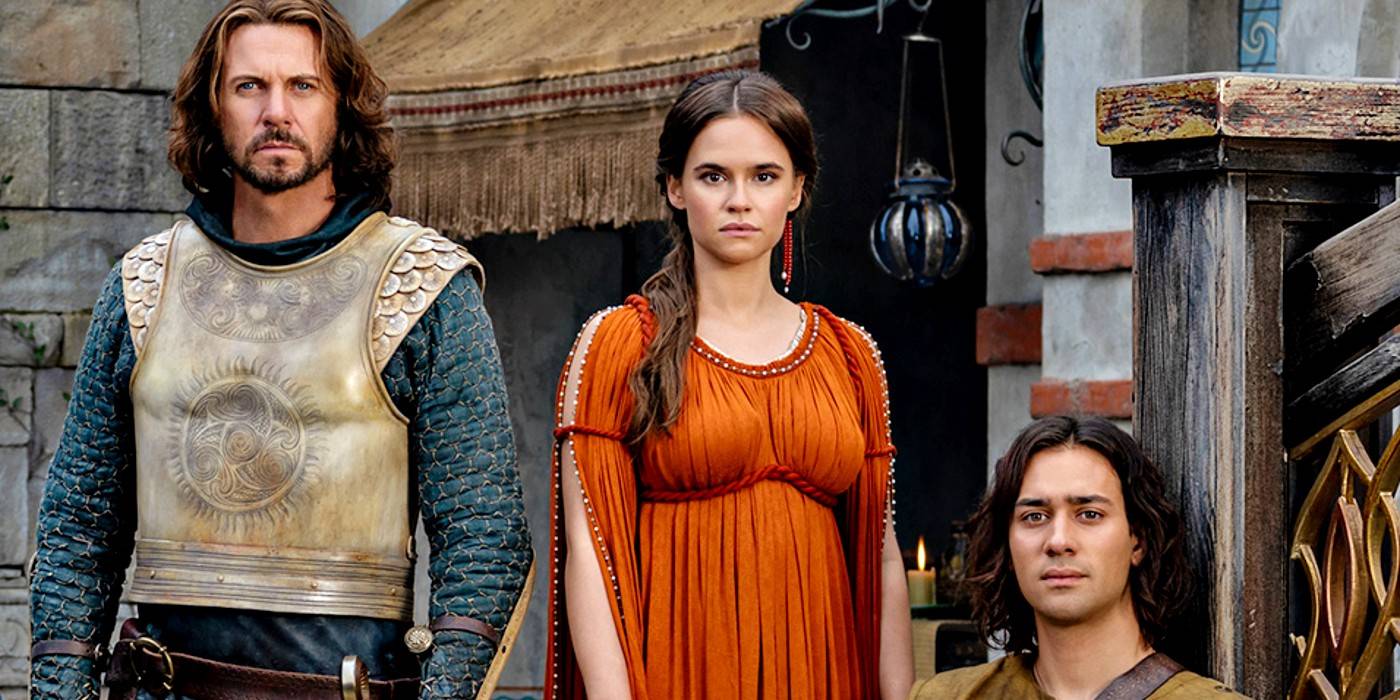
Arguably the most prominent new character in The Rings of Power episode 3 was Elendil of Númenor. Elendil is a name that will be familiar to fans of The Lord of the Rings trilogy, as he is a prominent figure in the world of men in the Second Age. In The Rings of Power though, Elendil is introduced as a sailor in the Númenórean fleet and the father of three children, Isildur from Lord of the Rings, Eärien, and Anárion. He is shown in the series as a friend to the elves, differing from many of his kin, and someone who speaks elvish. Elendil is played by Lloyd Owen in The Rings of Power. Owen is prominently known for his minor role in The Originals as Ansel, Apollo 18 as Nathan Walker, and Miss Potter as William Heelis. Owen is expected to have a starring role in the series from this point on, as are the actors who play his son and daughter...
Isildur - Maxim Baldry
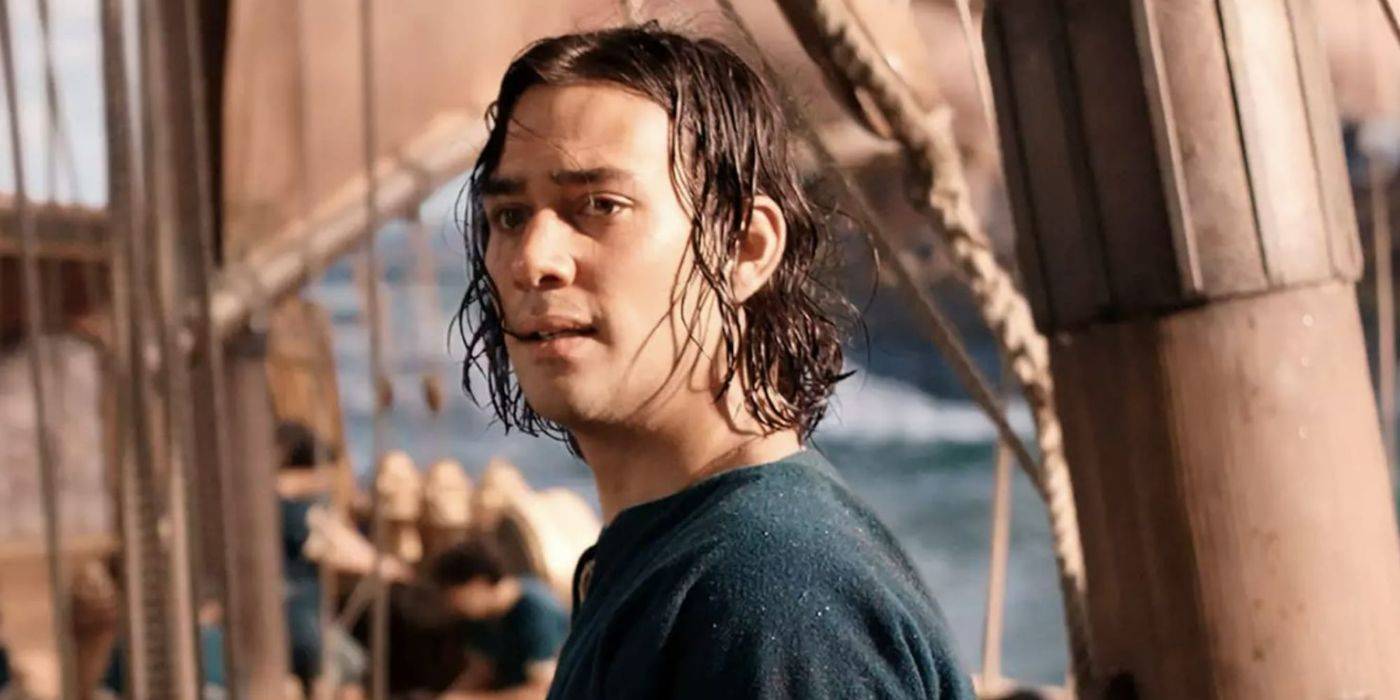
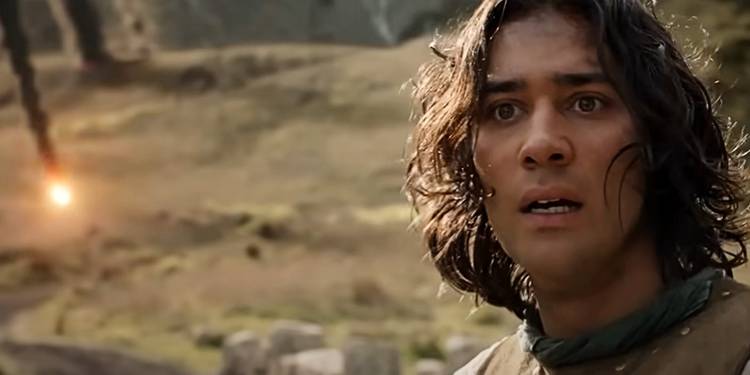
The son of Elendil, Isildur, is introduced in The Rings of Power episode 3. Isildur's name is even more well known in the lord of Middle-earth than his father's as he goes on to found the kingdom of Gondor late in the Second Age. In The Rings of Power, however, Isildur is shown to be a mere sailor like his father. Isildur is still in training to become part of the Sea Guard, Númenor's fleet and is nine days out from participating in the Sea Trial to see this a reality. The show, though, depicts Isildur as having doubts about joining the Sea Guard as he yearns to explore further than Númenor's shores. Isildur is portrayed by Maxim Baldry, a British actor known for his roles in Hollyoaks, a British soap opera, Rome, and film roles in Mr. Bean's Holiday and, more recently, Last Christmas.
Eärien - Ema Horvath
Eärien is the sister of Isildur and the daughter of Elendil. Unlike Isildur and Elendil, Eärien was created for the show and wasn't part of Tolkien's works. In The Rings of Power, Eärien is shown to be very close to Isildur who knows of his intentions to defer from the Sea Guard. However, the show also shows her as dealing with a lot herself and reveals that she was granted the role of an apprentice in the Builder's Guild. Similarly, Isildur convinced his sister to reapply to the Guild after she was initially rejected, again showing their close bond. Ema Horvath is the actress who portrays Eärien and is known for her roles in horror films such as The Gallows Act II and What Lies Below.
Tar-Míriel - Cynthia Addai-Robinson
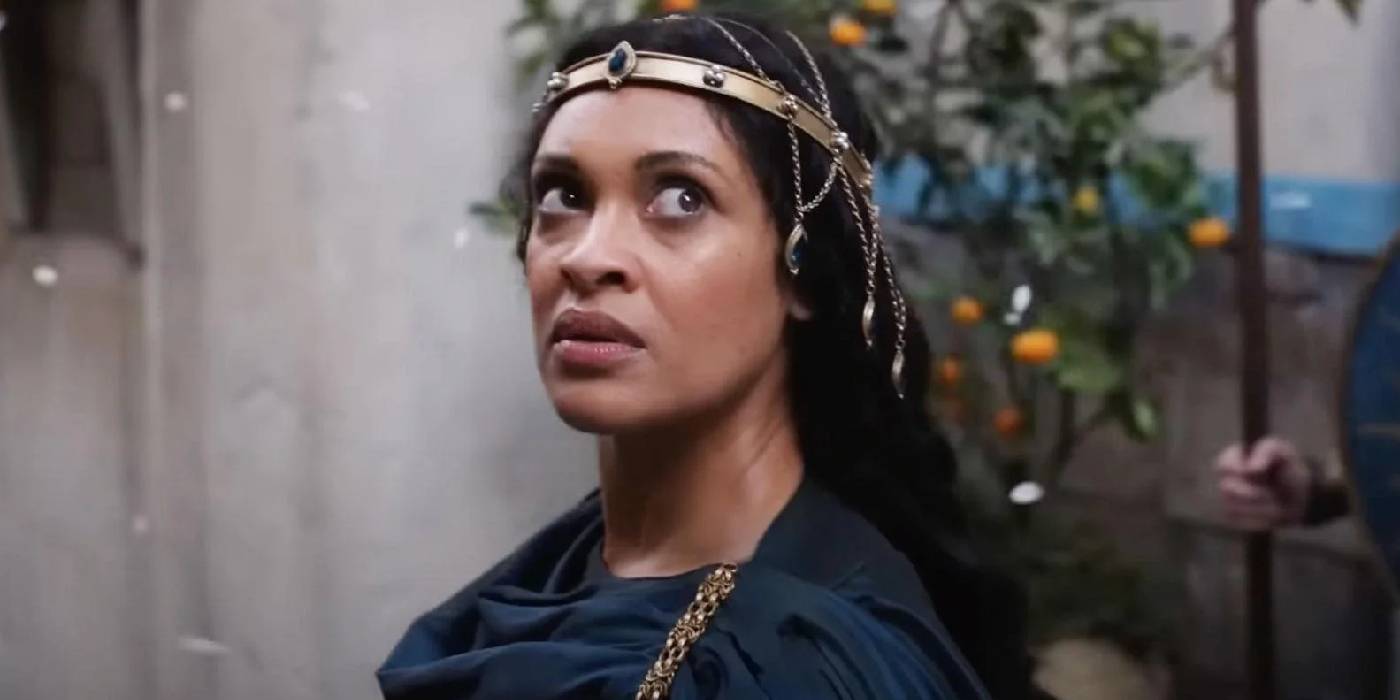
One of the other prominent characters of Númenor is Míriel, named Tar-Míriel, as she is the queen regent of the kingdom. Like the rest of her kingdom, Míriel is shown to be distrusting of elves, tasking Elendil with keeping a close eye on Galadriel (and Halbrand to an extent) while they are guests of Númenor. Also, she is shown to be expecting Galadriel's appearance, later saying to her father that the moment they've feared is here and that the elf has arrived. The queen regent is played by Cynthia Addai-Robinson known for her roles as Amanda Waller in Arrow, Naevia in Spartacus, and Nadine in Shooter, to name but a few.
Pharazôn - Trystan Gravelle
Pharazôn is an advisor to the queen regent of Númenor in The Rings of Power. Similarly to his superior, and the rest of the population, he seems distrustful of elves. The show portrays Pharazôn as holding a lot of influence in the decisions of the Númenórean royalty due to his orders being swiftly heeded by the guards of the throne room with little to no challenge from the queen regent herself in The Rings of Power episode 3. Trystan Gravelle plays Pharazôn and is mostly known for his work in Mr. Selfridge, The Terror, and A Discovery of Witches.
Adar - Joseph Mawle
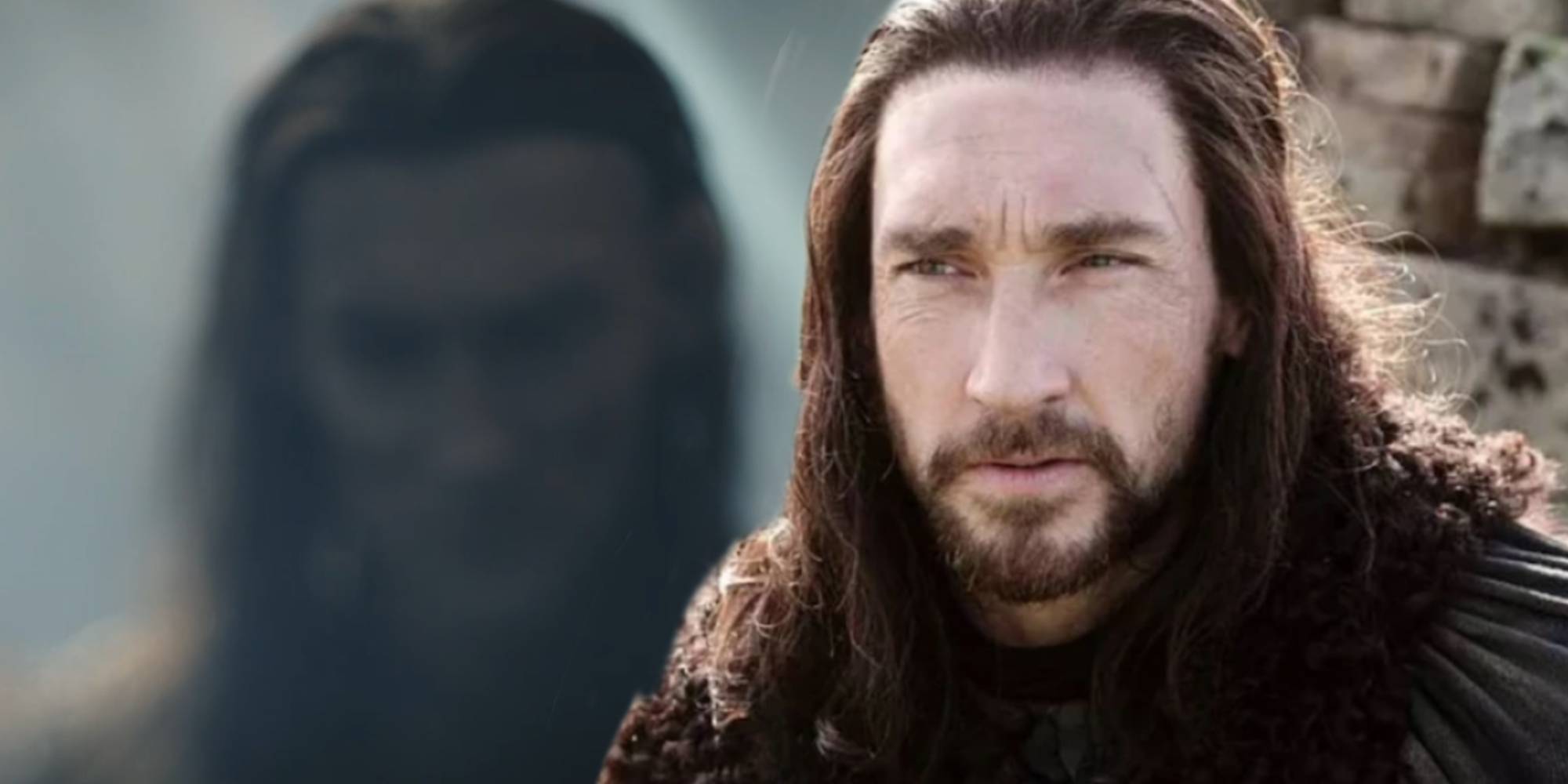
Adar is a character briefly introduced at the very end of The Rings of Power episode 3 and lends his name to the title of the episode. While the character doesn't have any dialogue in the episode or even an in-focus shot, it is clear from the way the orcs revere him that Adar is the leader of the orcs of the Southlands. In the episode, Arondir notes that Adar means father in elvish, with Adar leading the orcs or being their "father". Rumors of Adar's role in The Rings of Power have been circulating, hinting that he will be the main villain of season 1 of the show and the orc general who conducts Sauron's orders. If the rumors turn out to be true, then Adar will be played by Joseph Mawle, best known for playing Benjen Stark in Game of Thrones. While it remains to be seen if Adar will be the main villain, and the same one from Tolkien's lore, it is clear The Lord of the Rings: The Rings of Power is setting him up as a prominent character by lending his name to the title of episode 3 as well as ending the episode with his presence.
Episodes of Lord of the Rings: The Rings of Power air Thursdays/Fridays on Amazon Prime
The Rings Of Power is an Amazon original series. The first episode of The Rings Of Power premiered on Prime Video on 2nd September. The Rings Of Power is slated to have a total of 5 seasons comprising 50 episodes in total.
Amazon has reportedly spent over $1 Billion in producing this adventure fantasy series. After the release of 2 episodes of The Rings Of Power on Prime Video, the new episodes are slated to be released at midnight every week on Friday.
As the new episodes will air each week, the run time of new episodes will be updated once they are aired. This list contains the run time of episodes that have already been aired on Prime Video.
The first episode of The Rings Of Power S1 aired on 2nd September’22 and the last episode will be aired on 28th October’22. The show will have a release over the period of 2 months. The run time of each episode will be updated on the date of their release.
Here are some questions that you may encounter while watching The Rings Of Power.
What is the run time of The Rings Of Power episode 1 “A Shadow Of The Past”?
The run time of The Rings Of Power S1E1 ‘A Shadow Of The Past’ is 65 minutes.
What is the run time of The Rings Of Power episode 2 “Adrift”?
The run time of The Rings Of Power S1E2 ‘Adrift’ is 67 minutes.
Where to watch The Rings of Power?
The Rings Of Power will only be released on Prime Video. You need to have an active paid subscription to watch The Rings Of Power.
How many episodes in The Rings Of Power season 1?
There will be a total of 10 episodes in The Rings Of Power season 1.
Amazon’s much-awaited show The Rings Of Power was released on 2nd September. Upon release, The Rings Of Power received positive reviews from critics and fans.
So far, only 2 episodes of The Rings Of Power season 1 has released. The 2 episodes of The Rings Of Power were released together on 2nd September. Here’s looking at the release time of episode 3 of The Rings Of Power in Australia.
The Rings Of Power Season 1 Episode 3 Release Time in Australia
The release time of The Rings Of Power S1E3 from Australia’s Western Standard Time to Eastern Standard Time is:
The Rings Of Power Episode 3 Release Time in AWST
The 3rd episode of The Rings Of Power will release at 03:00 PM on the 9th of September according to the Australian Western Standard Time (AWST).
The Rings Of Power Episode 3 Release Time in ACST
The 3rd episode of The Rings Of Power will release at 04:30 PM on the 9th of September according to the Australian Central Standard Time (ACST).
The Rings Of Power Episode 3 Release Time in AEST
The 3rd episode of The Rings Of Power will release at 05:00 PM on the 9th of September according to the Australian Eastern Standard Time (AEST).
Where to watch The Rings Of Power Episode 3 in Australia?
In Australia, you can watch The Rings Of Fire only on Amazon Prime Video. As The Rings Of Power is an Amazon original series, it gets released only on Prime Video platform in the app and website.
Warning: spoilers ahead for The Rings of Power episodes 1 & 2
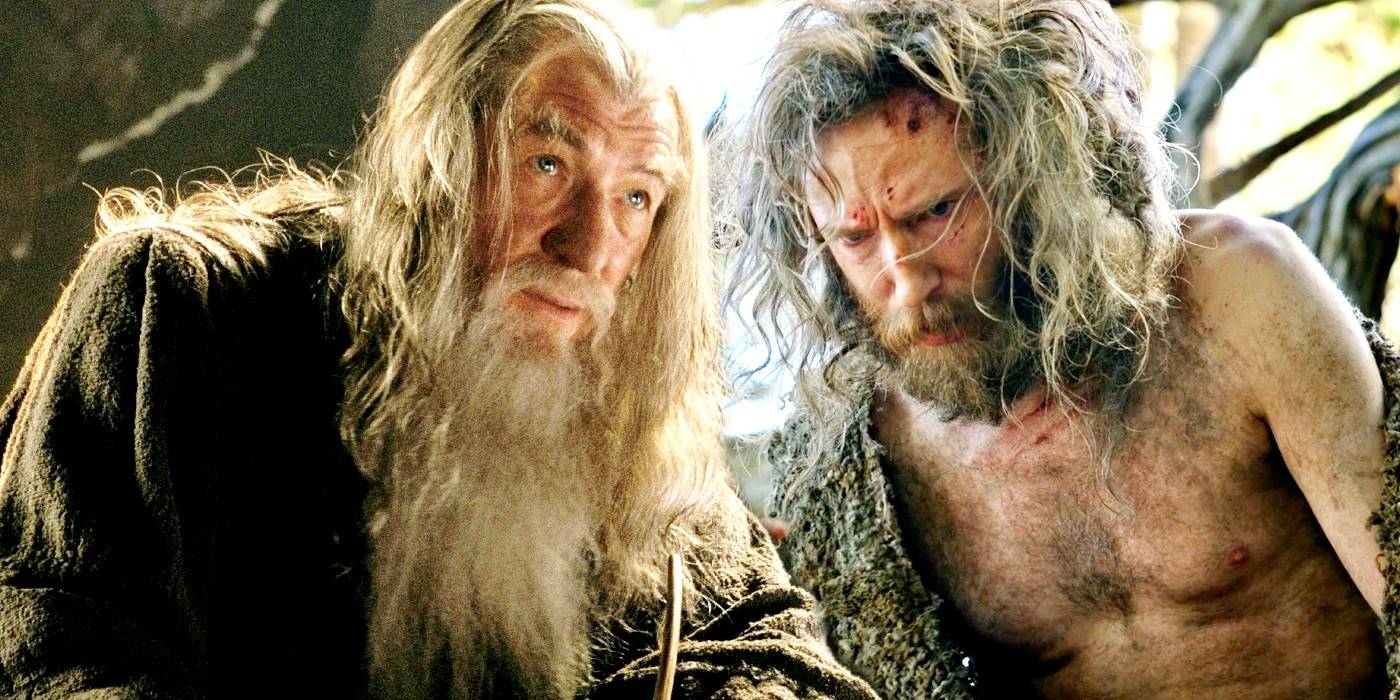
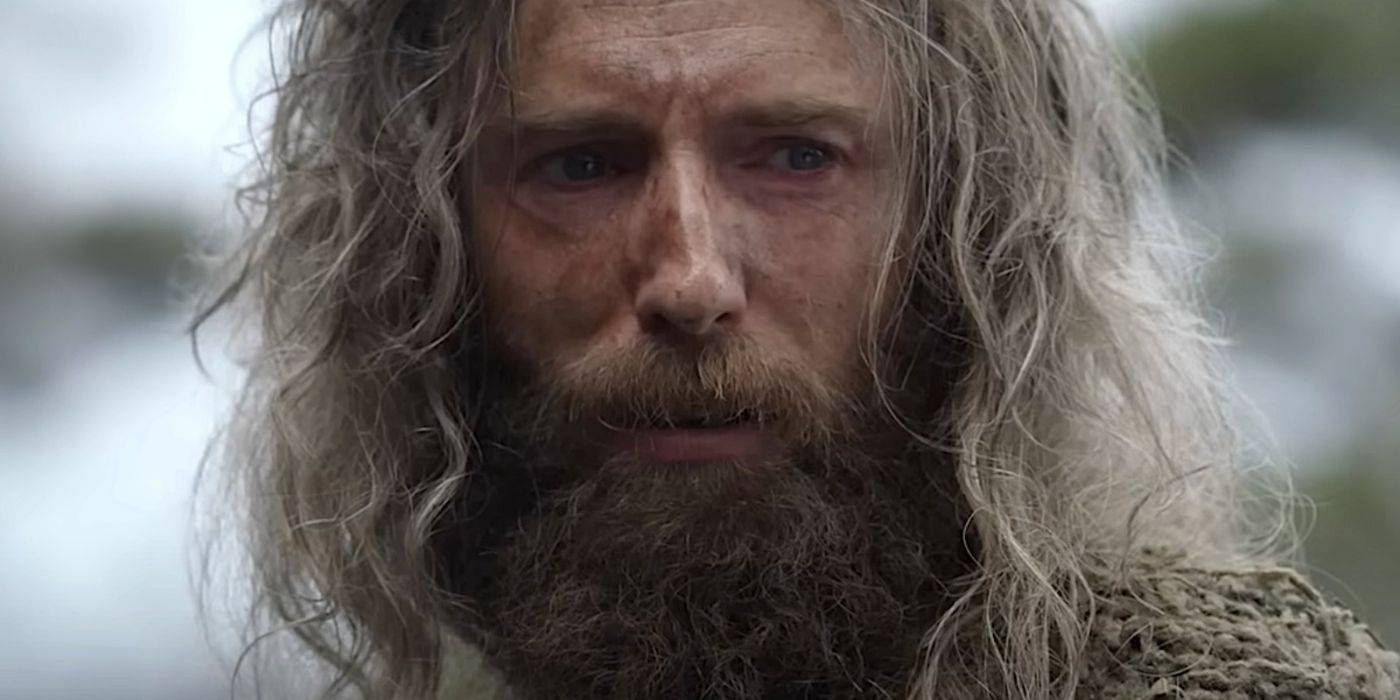
If it looks like Gandalf, enchants like Gandalf, and mumbles like Gandalf, is it a Gandalf? The Lord of the Rings: The Rings of Power dives into the weeds of this very conundrum. A huge mystery from The Rings of Power's opening two episodes is the identity of Daniel Weyman's character. Credited as "The Stranger" but more commonly known as Meteor Man, this odd soul falls from the skies of Middle-earth watched by Gil-Galad, Elrond, Celebrimbor, Bronwyn, Arondir, and Nori Brandyfoot, but it's the young Harfoot who actually finds him. Nori takes Meteor Man into her care with the begrudging help of friend Poppy, then later strikes up a tentative friendship with the enigmatic stranger.
Plenty of theories attempting to unravel The Rings of Power's Meteor Man mystery have already been proposed. Sauron is obviously a strong contender given The Rings of Power's focus, and although it's clear the Stranger possesses magical qualities, there's still a host of previously unseen Vala and Maia to pick from. Of course, Meteor Man could be an entirely new creation made especially for Amazon, holding no prior The Lord of the Rings connection whatsoever.
Another popular idea is that The Rings of Power will ultimately reveal its Stranger as Gandalf. The wizard does exist during The Rings of Power's timeline (albeit under the name Olórin), so the theory is at least plausible. The Rings of Power surely also knows what it's doing by introducing a scruffy sorcerer with a long beard dressed in gray.... who likes Hobbits... and whispers magic instructions to bugs like Gandalf in The Fellowship of the Ring. Amazon's The Rings of Power is almost coaxing audiences into assuming Meteor Man is an earlier Gandalf come to nip Sauron in the bud before he becomes a huge problem for Middle-earth, but is Nori really sharing her snails with The Lord of the Rings' most famous wizard?
Why The Old Man Likely Isn't Gandalf
According to J.R.R. Tolkien's mythology, Olórin lived with the other Maia in Aman, but always harbored a curiosity regarding the Children of Ilúvatar (Men and Elves), and would sometimes walk among them. In the Third Age, with Sauron launching yet another comeback, Olórin was one of five Maia chosen to visit Middle-earth and aid its inhabitants, adopting the human guise of Gandalf the Grey. While technically possible, the idea of Gandalf landing in Middle-earth during the Second Age to help fend off Sauron raises a whole slew of continuity wrinkles. Why would Olórin arrive via meteor rather than the usual boat? Why would he leave with the job half-finished? Did the Valar send him, or did Olórin come of his own accord? And does reaching Middle-earth so early contradict Tolkien's version of events, where Olórin needed much convincing before journeying there in the Third Age?
The Rings of Power episodes 1 & 2 also drop major hints that Meteor Man's true identity is much darker than wholesome dear-old Gandalf. When the Stranger first lands, a leaf falls before Gil-Galad's feet in Lindon, the underside of which is rotted by black poison. Meteor Man then seems to break Largo Brandyfoot's ankle when he becomes frustrated, before later killing all the fireflies he enchants. Hurting Harfoots, culling creatures, and fouling flora simply isn't in Gandalf's character - not even if those acts are committed subconsciously.
Meteor Man's physical appearance, general demeanor and use of magic all deliberately point viewers toward the same conclusion, and from a marketing perspective, it's not hard to see why Amazon would be tempted to include Gandalf in The Rings of Power. Alas, too many details aren't adding up. Far more likely, The Rings of Power's Stranger is Sauron, or a different member of the Ainur altogether.
The Lord of the Rings: The Rings of Power continues Thursday/Friday on Prime Video.
Sara Zwangobani, who is one of the stars set to feature in Amazon’s Lord of the Rings: The Rings of Power, has described how her character’s Harfoot family struggles in season 1. Based on the works of prolific fantasy author J.R.R. Tolkien, The Rings of Power is set during the Second Age of Middle-earth, thousands of years prior to Frodo and his friends setting out for Mount Doom during the events depicted in The Lord of the Rings. Amazon has spent big in their quest to bring Tolkien’s Middle-earth to their Prime Video streaming service, reportedly making an unprecedented production commitment worth at least $1 billion over five seasons.
In addition to seeing younger versions of characters familiar to Lord of the Rings fans, such as Galadriel and Elrond, The Rings of Power will also introduce a cast of new characters from amongst the varied peoples of Middle-earth. One such race expected to play a major role in the series are the Harfoots, distant ancestors and precursors to the Hobbits of the Shire. Unlike their Shire-bound kin, however, Harfoots are known for their nomadic lifestyles which would see them travel the wilds of Middle-earth.
Zwangobani, who plays the Harfoot known as Marigold Brandyfoot in The Rings of Power, recently spoke with Screen Rant during San Diego Comic-Con 2022. She offered new information about the Brandyfoot clan, teasing the internal struggle that lies among them. Check out Zwangobani’s full comments below:
They have lived a way of life for many generations. They expected that way of life to continue, and then something happens that upsets the balance of that. Part of the struggle is that there's some people in my family who are really ready to embrace the new, and there are some people like Marigold, who are just trying to protect what we have. And I think that's where the challenges lie.
While the histories of Middle-earth are all largely concerned with the doings of races like men, elves and dwarves, it is heartening to see that halflings will not be forgotten in this latest attempt at bringing Tolkien’s world to the screen. While there are some major differences between the Hobbits of the Third Age and their nomadic Harfoot ancestors, fans will be keen to see the influence that they have on helping shape Tolkien’s sprawling fantasy world. Hopefully, their inclusion will also go some way to explaining how Hobbits came to settle in the lands of Arnor and make their beloved home in the Shire.
Though the Brandyfoot family hasn't gotten much exploration yet onscreen, it sounds like The Rings of Power has found a unique and, perhaps, surprisingly relatable conflict within them. That should give the series a grounded edge. Amongst all the grand actions of mighty kings and brave warriors, and the inevitable rise of the Dark Lord Sauron, The Lord of the Rings has always put much stock in the actions of even the humblest people. Much as Lady Galadriel suggests in Peter Jackson’s The Fellowship of the Ring, “even the smallest person can change the course of the future.” Fans will finally get a chance to meet the Brandyfoot family and see how they will change the course of Middle-earth when Lord of the Rings: The Rings of Power hits Prime Video on September 2.
Ema Horvath, star of the upcoming The Lord of The Rings: The Rings of Power, says that the show will have a less apocalyptic look and feel than the movies. The Rings of Power is an upcoming show connected to The Lord of The Rings movie trilogy. In 2017, Amazon bought the television rights for The Lord of The Rings, committing to producing five seasons of a show in the same universe. Filming for The Rings of Power season 1 concluded in August 2021, and production for season 2 is set to begin later this year.
The Rings of Power series is set thousands of years before the events of The Lord of The Rings and The Hobbit, in a time period known as the Second Age. Compared to the Middle-earth fans of the franchise are familiar with, Middle-earth’s Second Age is much more peaceful, as the rise of the Dark Lord Sauron hasn't happened yet. The Rings of Power is developed by J.D. Payne and Patrick McCay and produced by Ron Ames and Christopher Newman. It stars Cynthia Addai-Robinson, Robert Aramayo, Owain Arthur, and Maxim Baldry.
Horvath, who plays Elendi’s daughter Eärien, exclusively tells Screen Rant just how different the universe of The Rings of Power will feel from The Lord of the Rings. She says that viewers may be surprised to see how “opulent” and “colorful” Middle-earth will look in the non-apocalyptic time Second Age. And since Eärien lives on Númenor, an island kingdom that fell by the time of The Lord of the Rings, viewers of The Rings of Power will get to see how “glorious” Númenor was before its fall. Check out Horvath’s full quote below:
Just how opulent it is. You watch the movies, and everything is kind of apocalyptic almost. Especially for my character, who is on Númenor. It's the most glorious, beautiful, vibrant, colorful thing in comparison to what we've seen before.
The Rings of Power has an extremely high budget, expected to exceed $1 billion over the five seasons. If all goes according to plan, that will mean The Rings of Power will have the highest budget in television history. Because the budget is so massive, fans have high expectations for the production design and VFX work for the series. Horvath’s description of the lush setting seems promising, and the production team certainly has the budget to live up to high fan expectations.
The show is not a direct continuation of The Lord of the Rings due to licensing issues. As a result, it will be interesting to see how the show sets up not only the world of the Second Age but also the brand new characters and storylines. The Lord of the Rings trilogy is one of the most beloved franchises of all time, but having The Rings of Power look and feel different isn't necessarily a bad thing. However, fans will have to wait until September of this year to see how The Rings of Power season 1 turns out.







.jpg?q=50&fit=crop&dpr=1.5)